Royal Aeronautical Society Podcast
The Royal Aeronautical Society is the world’s only professional body dedicated to the entire aerospace community. Established in 1866 to further the art, science and engineering of aeronautics, the Society has been at the forefront of developments in aerospace ever since.






Episodes
Jul 11, 2022
Jul 11, 2022
1 hr 24 min
Soon after the end of the First World War, Britain’s aircraft manufacturers’ minds were drawn back to a £10,000 prize for the first to fly an aeroplane across the Atlantic Ocean. Join Peter Elliott & David Broughton as they take us into the Vickers Vimy cockpits with pilot John Alcock and navigator Arthur Whitten Brown as they race to be the first to leave Newfoundland, fly and navigate across nearly two thousand miles of sea and finally set foot on European soil.
Peter Elliott & David Broughton addressed a joint seminar of the Royal Aeronautical Society’s Historical Group & the Royal Institute of Navigation on 6 July 2009. The podcast was edited by Eur Ing Mike Stanberry FRAeS.
Jun 13, 2022
Jun 13, 2022
1 hr 7 min
The first man to successfully fly over the Greenland ice cap chronicles how he, together with other figures such as Charles Lindbergh and Edward Byrd, used balloons, airships and aeroplanes to fly over the world’s great wildernesses and, in so doing, lay the path for air service routes across the roof of the world.
John Grierson lectured to the Royal Aeronautical Society’s Prestwick Branch on 12 March 1964. The recording was digitised thanks to a grant from the RAeS Foundation and the podcast was edited by Eur Ing Mike Stanberry FRAeS.
May 13, 2022
May 13, 2022
1 hr 50 sec
In late 1945 the Royal Aircraft Establishment hosted displays of German and British aircraft and equipment. It was the first opportunity that many people had to see - in detail and up close - a wide range of aircraft that until recently had been either closely guarded, such as the Spiteful and Martin Baker MB 5, or cause for alarm, such as the Dornier Do 335 and Messerschmitt Me 262. German missiles as well as German and British jet engines were also shown, giving a fascinating glimpse of what might be to come.
Amongst the crowds was a young Mike Bowyer and, nearly seventy years later and after a career as an aviation historian and journalist, he conjurers up the two days he spent exploring the all corners of the exhibition and tells us about the amazing aircraft he encountered.
Michael J. F. Bowyer addressed a meeting of the Royal Aeronautical Society’s Historical Group on 17 November 2014 and the podcast was edited by Eur Ing Mike Stanberry FRAeS.
Apr 19, 2022
Apr 19, 2022
56 min
How was the USA’s quest to get the first man on the moon going halfway between JFK’s pledge and Neil Armstrong’s first giant step? Colonel John Glenn, the first American to orbit the earth, reviews NASA’s achievements before giving us a stage-by-stage view of how NASA was planning to get an astronaut to the moon and back.
The lecture concludes with a fascinating question and answer session. A longer version of this recording, which includes Glenn talking through a range of images from the Space Programme, can be found on the RAeS website.
Colonel John Glenn addressed the Royal Aeronautical Society on 8 October 1965. The recording was digitised thanks to a grant from the RAeS Foundation and the podcast was edited by Eur Ing Mike Stanberry FRAeS.
Mar 14, 2022
Mar 14, 2022
1 hr 1 min
An American showman turned aviator, Samuel Franklin Cody used his imagination, endless courage and engineering virtuosity to become the first man in Britain to fly in an aircraft of his own making. But can he rightly take a place amongst the world’s heroes?
In this lecture, historian Peter Reese tells the story of how a man moved from performing a Wild West Show to becoming an aeronautical pioneer by building and flying some of the earliest man-carrying kites and aeroplane, before showing how, once the War Office declared against constructing aeroplanes in favour of airships, he raced his own aeroplanes and outflew his contemporaries.
Peter Reese addressed the National Aerospace Library’s volunteers on 29 November 2021 and the podcast was edited by Eur Ing Mike Stanberry FRAeS.
Feb 9, 2022
Feb 9, 2022
48 min
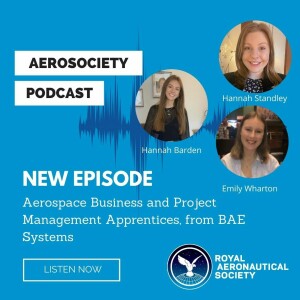
RAeS has joined with Apprentices From BAE Systems to let you know what to expect from an apprenticeship. This Podcast hears Hannah, Emily and Hannah talk about why they chose an apprenticeship, how they felt about the application process, what their days work looks like and so much more.
Feb 8, 2022
Feb 8, 2022
1 hr 48 min
One of the first aircraft manufacturers in the UK, Martin & Handasyde, later to be known as Martinsyde Ltd, became Britain’s third biggest manufacturer during the First World War and designed aircraft for the race across the Atlantic and from the UK to Australia. J. M. Bruce explains the history of this short-lived company and untangles the ‘threads of development’ that linked each of Martinsyde’s aircraft types.
The recording concludes with a short question and answer session that includes reminiscences of George Handasyde’s deputy in the years after he left Martinsydes.
J. M. Bruce MRAeS addressed a meeting organised by the Royal Aeronautical Society’s Historical Group on 26 February 1968. The lecture was introduced by J. L. Nayler FRAeS FAIAA, the recording was digitised thanks to a grant from the RAeS Foundation and the podcast was edited by Eur Ing Mike Stanberry FRAeS.
Feb 7, 2022
Feb 7, 2022
36 min
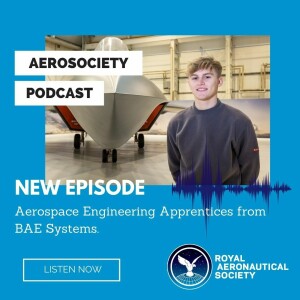
RAeS has joined with Apprentices From BAE Systems to let you know what to expect from an apprenticeship. This Podcast hears Chris and Jay talk about why they chose an apprenticeship, how they felt about the application process, what their days work looks like and so much more.
Jan 11, 2022
Jan 11, 2022
1 hr 45 min
Kenneth Owen takes us through the twists and turns of the Anglo-French campaign to persuade the Americans to allow the supersonic aircraft to land in New York. He highlights how the French Aérospatiale and British BAC used different strategies to persuade American politicians and the judiciary to accept Concorde on the transatlantic route and shows the hoops that the manufacturers had to jump though in order to overcome environmental concerns held in both Washington DC and New York.
Owen begins his story by examining British attempts to get an Anglo-American supersonic project off the ground and also explores how the British and French team persuaded the FAA to give the aircraft type certification that would enable US airlines to fly the supersonic airliner.
The recording includes a fascinating discussion with members of the audience, which included former politicians, civil servants and British Airways employees that were directly involved in the story.
Kenneth Owen FRAeS gave his lecture to a meeting organised by the Royal Aeronautical Society’s Historical Group on 29 April 1997. The lecture is introduced by Frank Armstrong FRAeS, the recording was digitised thanks to a grant from the RAeS Foundation and the podcast was edited by Eur Ing Mike Stanberry FRAeS.
Dec 1, 2021
Dec 1, 2021
45 min
In the heat of World War II, John Charnley was sent from his red-brick university to the heart of aero research in the UK, the Royal Aircraft Establishment in Farnborough. In this archive recording, Sir John describes the transition into the RAE Aerodynamics Department’s Flight Test Division and his work on many of the problems associated with high-speed flight, starting with work on the Gloster E.28/39 which tested Whittle’s jet engine.
After twelve years Sir John moved from the very fast to the very slow, when he was sent to head the RAE Blind Landing Experimental Unit. Charnley explains how he helped to move the Unit’s purely military work landing V-bombers in poor conditions, to include civil applications leading to the development of the AUTOLAND system. A fuller account of the work of the Blind Landing project can be found in Sir John’s Journal of Aeronautical History paper at https://www.aerosociety.com/JAHblindlanding.
Sir John Charnley was interviewed as part of the DERA Oral History Project in 2000 and the recording was edited by Eur Ing Mike Stanberry FRAeS.